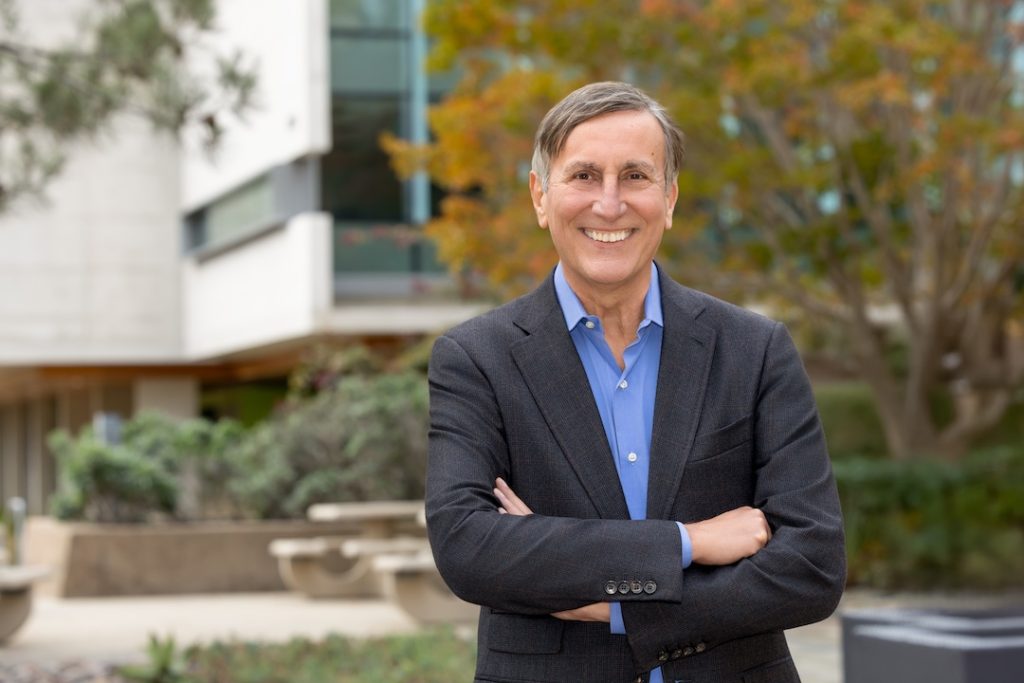

Erik Ehinger, Ph.D., is working to give T cells a boost. If his strategy succeeds, he could help the immune system fight cancer in an entirely new way. His weapons of choice? Unstoppable T cells.
Ehinger is a postdoctoral researcher at La Jolla Institute for Immunology (LJI). He’s also an inventor.
Ehinger’s work recently won top honors in the Nucleate San Diego Activator Program. These award winnings will help his company, Bendu Therapeutics, move forward with a new drug approach for cancer immunotherapy patients.
The problem: T cells need help
The immune system’s T cells constantly scan the body for signs of disease, and they swoop in to destroy sick cells before infection can spread.
T cells can even fight cancers. Sometimes T cells kill cancer cells on their own, and sometimes they need help. Over the last two decades, researchers have designed cancer immunotherapies, such as CAR-T therapies, that make it easier for T cells to recognize and destroy abnormal cancer cells.
Cancer immunotherapies have saved many lives, but they don’t work for every patient. Some patients seem to improve at first, only to eventually have their T cells fail due to a phenomenon called T cell “exhaustion.”
“The T cells lose their ability to fight. So it’s almost like they literally get exhausted,” says Ehinger.
Ehinger’s mentor, LJI Professor Anjana Rao, Ph.D., is a pioneer in the field of T cell biology. In recent years, Rao discovered that a family of molecules called NR4A transcription factors drive T cell exhaustion.
Through gene editing, Rao and her colleagues showed that you can prevent T cell exhaustion by blocking NR4A transcription factors. “If you knock them all out, T cells become really good at killing cancer cells,” says Ehinger.
Could a drug treatment do the same thing? Ehinger and Rao discussed an idea that drove his PhD research.
The approach: Ehinger tested whether he could use a specially engineered molecule called a Proteolysis Targeting Chimera (PROTAC) to destroy NR4A transcription factors.
“A PROTAC is a dumbbell-shaped molecule. One end of the dumbbell binds to a protein that you want to eliminate, and the other end recruits what we call the ‘rubbish disposal system,’” says Ehinger. “The link between the two sides pulls the ends together, and basically turns on the garbage disposal. It turns the unwanted protein into little pieces until it is eliminated.”
The problem: How to reverse T cell exhaustion
Based on the previous studies from Rao’s lab and his own experiments, Ehinger thought that this approach might be able to reverse T cell exhaustion in humans, so he applied for independent funding through LJI’s Tullie and Rickey Families SPARK Awards for Innovations in Immunology. In 2023, Ehinger won $25,000 in funding through the generosity of LJI Board Director Dave Rickey and the Rickey Family.
“The SPARK program gave me the early academic seed funding to do the first few experiments to see if this approach had legs,” says Ehinger.
In his SPARK experiments and for his PhD research, Ehinger used a custom PROTAC molecule to destroy NR4A transcription factor molecules and keep cancer-fighting T cells going strong. “It did a really nice job of bringing back T cell function,” he says.
That’s when Ehinger and Rao decided to pursue the next steps in bringing this potential treatment to cancer patients. They received a $250,000 Discovery Award from Curebound, a San Diego-based non-profit that funds innovative cancer research.
With this funding, Ehinger and Rao found that the PROTAC strategy could reverse T cell exhaustion in both mouse and human T cells. But how to bring this strategy to patients?
Scientist, inventor, entrepreneur
At this time, a different PROTAC strategy was making headlines.
Yale scientist Craig Crews, Ph.D., had pioneered PROTAC research in the early 2000s. By the 2020s, several pharmaceutical companies were testing PROTAC molecules as a way to destroy cancer cells. One PROTAC-based therapy, called VEPPANU™, targets certain types of breast cancers by destroying the essential estrogen receptor protein on cancer cells.
As Ehinger was working on his SPARK project, VEPPANU™ was under review by the U.S. Food and Drug Administration and was eventually approved in May 2026.
Ehinger and Rao were the first to pursue PROTACs as a way to counteract T cell exhaustion. As Ehinger shared his SPARK experiment findings, he was approached by several LJI supporters who encouraged him to look into commercial development for the PROTAC strategy.
Ehinger had imagined himself as an academic, not an entrepreneur. But now he had invented something, and Nucleate San Diego gave him a chance to see how far it could go.
Nucleate San Diego is a non-profit, student-run organization for inventors just like Ehinger. Nucleate’s Activator Program is designed to help scientists in the biomedical field translate their research into a viable business venture. In fact, the Activator Program was recently named one of America’s Best Incubators and Accelerators of 2026 by TIME.

At the beginning of the program, inventors match with fellow scientists and business students to form a team “company.” Through expert-led workshops, each finalist team has the opportunity to meet 1-on-1 with local biotech ecosystem professionals that help them to build and “de-risk” their company.
New ideas, big awards
Each spring, company founders pitch their company at Nucleate’s Demo Day. The best pitches are awarded with resources to help teams progress their company after the Activator. Teams are assessed both locally and globally and selected for strategic introductions to top biotech companies, free lab space, and even credits to help with the legal costs of incorporating their company.
Ehinger called his company Bendu Therapeutics. His team members included LJI Senior Project Manager Roberta Nowak in the Rao-Hogan Labs and UC San Diego Graduate Student Qin Hui Li, who is a member of LJI’s Shresta Lab.
In May 2026, Ehinger led Bendu Therapeutics in Nucleate San Diego’s Demo Day. His team won three awards that day: the Genentech Biology Explorers Award, the Cooley Startup Innovator Legal Credit Award, and the BioLabs Golden Ticket. The Genentech Biology Explorers Award was a global competition with 180 teams competing across the Activator Program.
“It was incredible,” says Ehinger.
Ehinger is now working closely with LJI’s Legal Affairs and Intellectual Property Department to “spin off” the PROTAC strategy and make Bendu Therapeutics a reality. He has also received $100,000 in funding through a philanthropy associated with venture capital firm Medical Excellence Capital LLC, which includes Managing Partner Kim Kamdar, Ph.D., also a member of the LJI Board of Directors. “That funding has allowed us to build off of our Discovery Award from Curebound,” says Ehinger.
And Ehinger hasn’t stopped improving the PROTAC approach. Right now, he’s tweaking PROTAC molecules to help them bind even more strongly to NR4A transcription factors.
“We’re right at the threshold where we could start going to the next step of drug discovery,” says Ehinger.
Why “Bendu” Therapeutics?
Ehinger pulled from sci-fi inspiration when choosing a company name. He’s a fan of the show Star Wars Rebels, which features a creature called Bendu. “Bendu has this ability to stabilize the light and dark side of the force. So I think of that as a link with how we’re trying to balance the immune system and cancer, if you will,” says Ehinger.
Ehinger also learned of the Sanskrit word “bandhu,” which is related to the idea of bonding with a kinsman or friend. This meaning seemed appropriate since PROTAC molecules have two portions that are linked.
And so Bendu Therapeutics was born.