LA JOLLA, CA — In an international collaboration, researchers from the group of Tuğçe Aktaş, Ph.D., from Max Planck Institute for Molecular Genetics, in collaboration with scientists from La Jolla Institute for Immunology (LJI) and Kyoto University, have discovered how mysterious cell structures nicknamed “speckles” help our cells stay healthy.
Their new study, published in Cell, shows that nuclear speckles help process dense sections of genetic code. This discovery provides an answer to the long-standing question of the function of these mysterious cell structures.
With this better understanding of nuclear speckles, researchers can investigate cancers and other diseases where nuclear speckles often appear mutated.
The problem with speckles
Nuclear speckles have long puzzled scientists. With the advent of light microscopy researchers first observed granular structures within cell nuclei. Yet these speckles were not formally recognized as distinct nuclear entities until the mid-20th century. Advanced molecular biology methods finally revealed what the speckles were made of, but this insight only raised even more questions.
“Broadly speaking, the field was considering two different ideas,” says Aktaş. “Some scientists thought they were a gene-expression regulatory hub because they contain many transcription- and splicing-related proteins. Others believed that speckles simply store these molecules until they are needed and are not functional bodies.”
Solving this mystery wouldn’t be easy. In molecular biology, scientists usually learn a lot by deleting a structure or protein of interest and then observing the resulting effects on cells and biological processes. However, this basic approach was hindered by the complexity of nuclear speckles.
“They contain hundreds of proteins, and it was unclear which ones formed the core of these condensates,” says Michal Malszycki, one of the study’s first authors. This complexity made it impossible for scientists to know which proteins to delete.
Speckles help splice, package, and protect
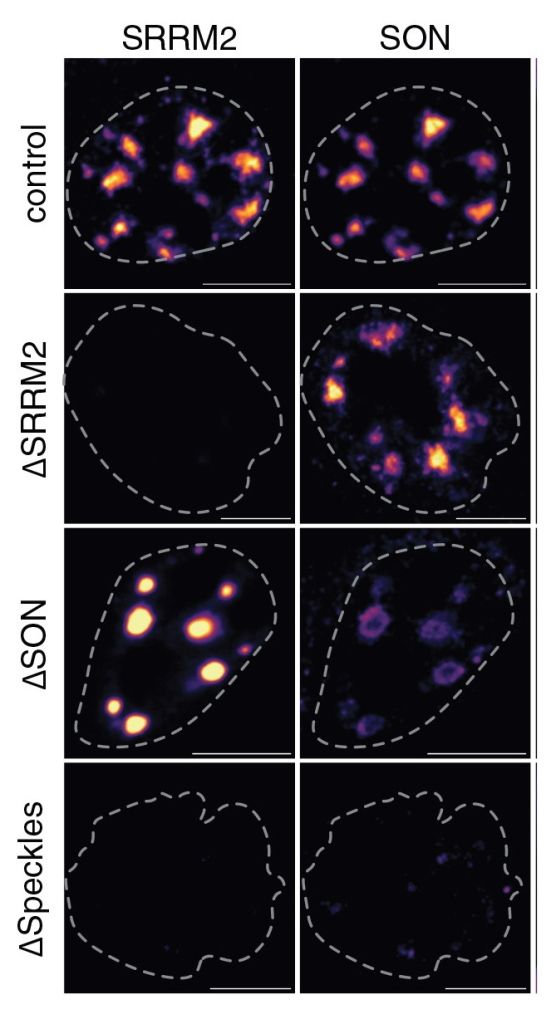
This changed in 2020, when the Aktaş Lab identified the two proteins that form the scaffold of nuclear speckles: SON and SRRM2. In their new study, the researchers targeted these proteins with degraders and were finally able to disrupt the structures. “By dismantling speckles, we found that they have a clear function and are not merely storage spaces,” says Aktaş.
Specifically, the team linked speckle function to regions of DNA known as GC-rich isochores, which are large segments of DNA that are highly enriched in guanine and cytosine bases.
“These GC-rich regions are dense with genes, and the messenger RNA produced from them is difficult to splice by default,” explains Lisa Martina, another first author. “We can now show that speckles are needed to properly process this tightly packed gene architecture.”
LJI Associate Professor Ferhat Ay, Ph.D., worked closely with the Aktaş Lab to uncover a second important function for nuclear speckles. By analyzing the 3D organization of DNA from cells with and without speckles, the LJI team showed that nuclear speckles provide a physical scaffold to keep sections of DNA and other proteins — packaged into chromatin fibers — in place in the cell nucleus. By restricting random chromatin movements, nuclear speckles help prevent scrambling of genetic information.
“If you take those speckles away, there is more intermingling and intermixing of parts of DNA that usually do not talk to each other,” says Ay.
Showing the increase in such intermingling was not an easy task, explains Daniela Salgado-Figueroa, a bioinformatics Ph.D. student at UC San Diego and member of the Ay Lab at LJI. The group used cutting-edge long-read sequencing-based techniques to profile the 3D organization of the DNA.
“This new type of data offered its unique challenges but also allowed us to quantify higher order interactions among different parts of the DNA,” says Salgado-Figueroa.
Detecting these interactions isn’t possible using traditional short-read based sequencing. Oxford Nanopore long-read sequencing, established in the Ay Lab, has been instrumental in advancing new research into how higher order interactions play out between more than two regions of DNA.
A new direction for medical research
A deeper understanding of speckles could provide important insights into the mechanisms behind many diseases. Scientists have found that the core proteins of nuclear speckles are frequently mutated in rare disorders, and there are some recent studies that report changes in the composition and morphology of speckles in cancer.
Ay says his lab is investigating the possible role of nuclear speckles in an aggressive subtype of B cell leukemia, where one of the genes studied in this collaboration, SON, is often overexpressed.
More broadly, biomolecular condensates, such as nuclear speckles, are increasingly implicated in key cellular functions and in many diseases.
“There were all these ideas about what nuclear speckles might be doing, and it is very exciting that we can clearly link them to the processing of the GC-rich isochore-derived RNA. To the best of my knowledge, no one has ever described a nuclear condensate that specifically affects such large domains of the genome,” says Aktaş.
The next speckle mystery
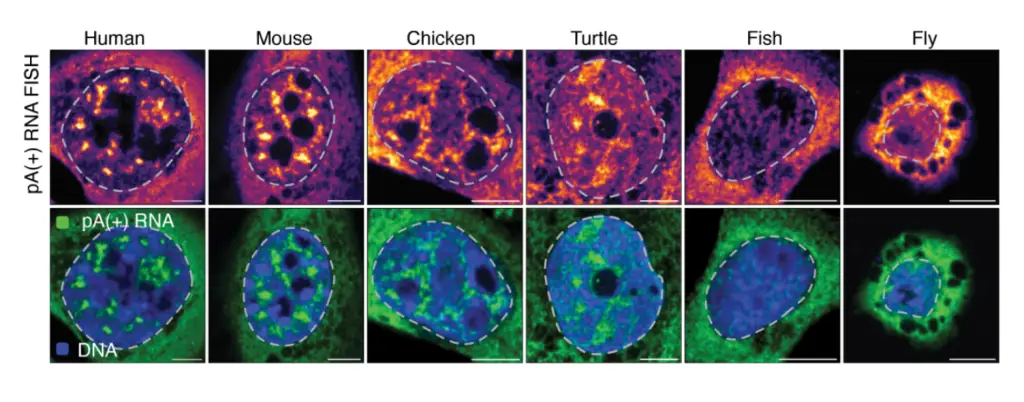
The scientists also performed experiments in cell lines of other species, some of which were only available thanks to their collaborator Cantas Alev, M.D., Ph.D., at ASHBi in Kyoto. They discovered that speckles seem to have evolved in amniotes, such as mammals and birds, together with the gene architecture that is difficult to splice. Interestingly, this genetic architecture is absent in fish and invertebrates.
“We found that speckles and the GC-rich isochores have co-evolved,” says İbrahim Ilık, Ph.D., a postdoc in the Aktaş Lab and a co-author of the paper. “Why isochores exist, or what advantage such gene architecture provides, remains controversial. But this finding raises important questions about the evolution of speckles and their roles in other species, which we will now pursue further.”
Additional authors of the study, “Nuclear speckles enable processing of RNA from GC-rich isochores,” include Daniela Salgado Figueroa and Nirmalya Dasgupta of LJI, Menşura Feray Çoşar, Keun-Tae Kim, Gil Daniel Bregieiro Carraco, Beatrix Fauler, David Meierhofer, Thorsten Mielke, and Hiroo Imai.
This study was supported by the Max-Planck Society; project no. 507866755 of DFG Schwerpunktprogramme 2202; the National Institutes of Health (grant R35-GM128938), and the World Premier International Research Center Initiative (WPI), MEXT, Japan.
###
Written by Madeline McCurry-Schmidt of La Jolla Institute for Immunology and Sándor Fülöp of Max Planck Institute for Molecular Genetics. Read the press release by Max Planck Institute for Molecular Genetics