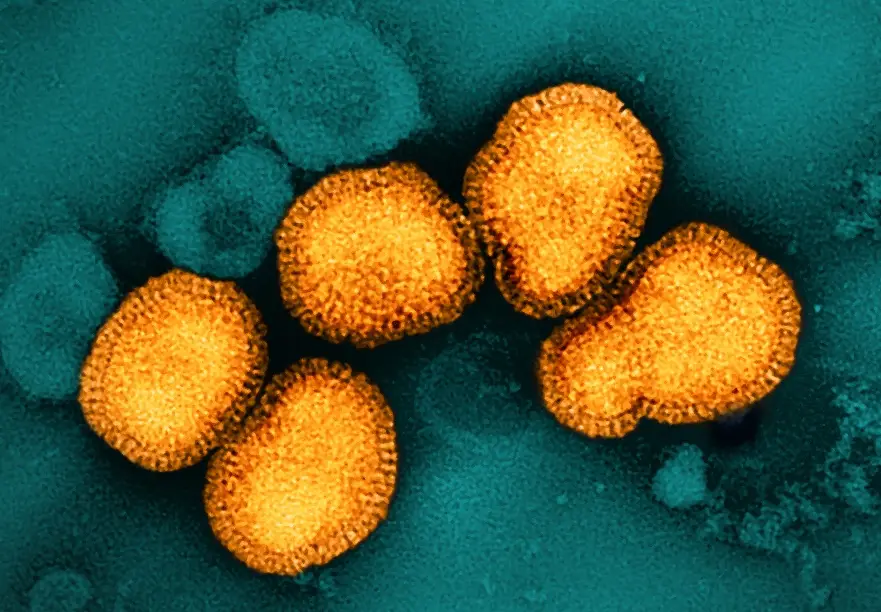
LA JOLLA, CA—La Jolla Institute for Immunology (LJI) Professor, President & CEO Erica Ollmann Saphire, Ph.D., MBA, and LJI Professor and President Emeritus Mitchell Kronenberg, Ph.D., have been elected to the American Academy of Arts and Sciences.
Saphire and Kronenberg are recognized for their scientific discoveries and leadership in the fields of microbiology and immunology. They were selected for the honor by their peers in the sciences—and are among only eight U.S. microbiologists and immunologists elected to the Academy this year. The most recent LJI scientist to join the Academy was LJI Professor and Chief Scientific Officer Shane Crotty, Ph.D., who was elected in 2025
The Academy was founded in 1780 by John Adams, John Hancock, and 60 other early American leaders who aimed to gather knowledge and address problems in society. Academy members have included Benjamin Franklin, Martin Luther King, Jr., Jonas Salk, and Madeleine Albright.
Both Saphire and Kronenberg reflected on what this honor means to them as scientists and as Americans.
“My family originally came to this country on the Mayflower.” says Saphire. “Through all those generations, it has been important to us to build the nation with whatever tools we had, be it plow, pen, paintbrush, or pipette,”
“My grandparents came to the United States from Eastern Europe because they were escaping persecution and looking for opportunity,” says Kronenberg. “This country has given a lot to me, I have a deep feeling of gratitude that the Academy recognized my work.”
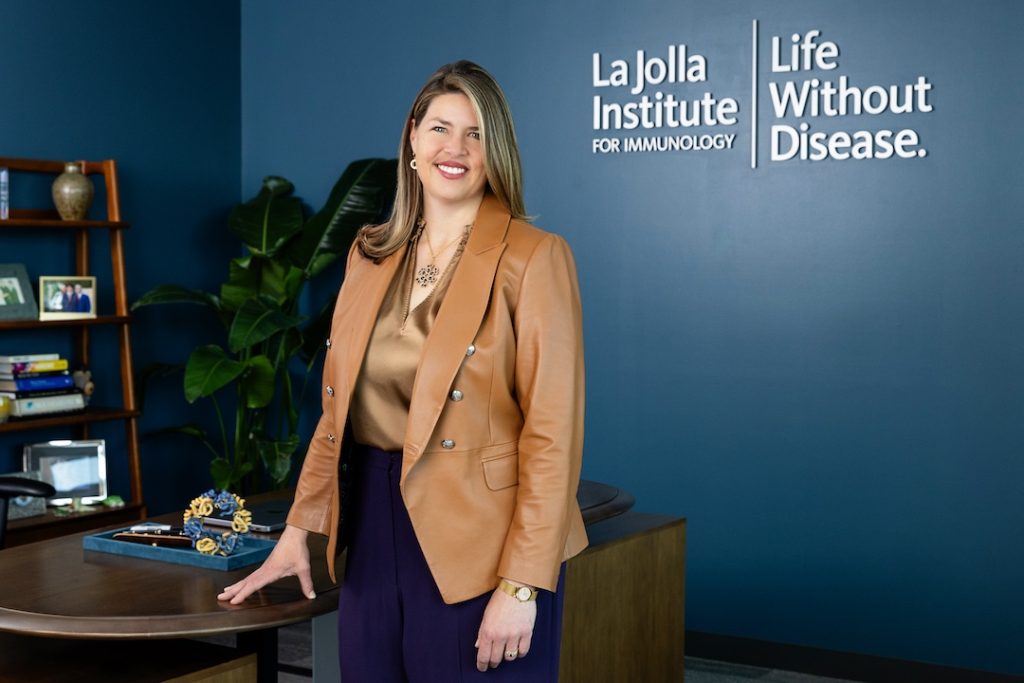
LJI Professor, President & CEO Erica Ollmann Saphire, Ph.D., MBA
Saphire is a structural biologist and immunologist studying some of the world’s worst viruses. Her lab uses high-resolution imaging techniques to capture hidden interactions between viral machinery, human cells, and human antibodies. This kind of microscopic reconnaissance reveals how viruses attack human cells—and how antibody-based therapies might block infections and save lives.
As a graduate student at Scripps Research, Saphire harnessed a technique called x-ray crystallography to solve the first structure of an entire human antibody. She went on to focus on hemorrhagic fever viruses as a faculty member at Scripps Research.
Saphire was the first scientist to solve the structures of the cell-entry proteins of Lassa, Marburg and the Ebola viruses. Saphire’s research revealed how rare human antibodies can target key sites on these proteins, and she showed it could be possible to develop antibody “cocktails” to neutralize infection.
Saphire’s work often took her to Sierra Leone, Africa, where she worked closely with local scientists and doctors to study antibodies found in the blood of Lassa virus survivors. In 2013, West Africa was hit with its first-ever Ebola virus outbreak. Between 2013 and 2016, Ebola virus killed at least 11,323 people in West Africa, including colleagues Saphire had worked with in Sierra Leone.
Amidst the outbreak, Saphire established the Viral Hemorrhagic Fever Immunotherapeutic Consortium, uniting former competitors to quickly advance antibody-based treatments against Ebola virus. Her lab went on to help develop a rapid test to diagnose Ebola virus infection.
In 2019, Saphire joined LJI and launched a new era of structural immunology research. Her lab has advanced the use of cryo-electron microscopy for studying pathogens such as measles virus, rabies virus, ancient retroviruses that form the dark matter in the human genome, as well as modern threats that trigger autoimmune disease, cancer, and birth defects.
In 2020, Saphire established the Coronavirus Immunotherapy Consortium (CoVIC) and united labs around the world in an effort to collect and evaluate nearly 400 human antibodies with the potential to neutralize SARS-CoV-2, the virus that causes COVID-19. Through CoVIC, Saphire showed how human antibodies could bind to different pieces of the SARS-CoV-2 structure to prevent infection and streamlined analysis pipelines to accelerate progress should there be a future pandemic.
Today, Saphire serves as President and CEO of LJI. Under her leadership, the Institute established the LJI Center for Sex-Based Differences in the Immune System. Saphire also leads “America’s SHIELD: Strategic Herpesvirus Immune Evasion and Latency Defense,” a national collaboration funded by the U.S. Government’s Advanced Research Projects Agency for Health (ARPA-H), to protect against herpesviruses such as Epstein-Barr virus and cytomegalovirus (CMV), which are major global health concerns.

LJI Professor and President Emeritus Mitchell Kronenberg, Ph.D.
Kronenberg has advanced our understanding of the roles of T cells in fighting cancers and infections—as well as how these cells drive autoimmune diseases such as diabetes and multiple sclerosis.
Since his early scientific training, Kronenberg has had a deep interest in the field of mucosal immunity—how immune cells function in our vulnerable “barrier tissues,” such as the linings of the intestine and the lungs.
To understand mucosal immunity, Kronenberg focused on two T cell subsets: invariant natural killer T (iNKT) cells and mucosal-associated invariant T (MAIT) cells, often called innate-like T cells. Both cell types are tissue-resident and participate in the body’s innate immune response—our team of “first responder” immune cells—as well as in adaptive immunity.
Kronenberg has shown how these T cells defend the body, but his work also highlights how T cell immunity can go wrong. His lab has uncovered how “progenitor” cells feed the supply of inflammatory T cells that damage our barrier tissues and lead to inflammatory bowel disease, which includes Crohn’s disease and ulcerative colitis.
Together with LJI William K. Bowes Distinguished Professor Pandurangan Vijayanand, MD, Ph.D., Kronenberg’s lab recently launched an investigation into an autoimmune disease called primary biliary cholangitis (PBC), a condition that mostly affects women, in which bile ducts are attacked, leading to liver dysfunction. They are analyzing all T cell populations in the liver, but focusing on MAIT cells, which constitute up to 25 percent of the T lymphocytes in the liver.
There is currently no cure for PBC, but if Kronenberg’s research proves that MAIT cells or progenitor T cells are important, that would point to potential therapeutic targets. “If we can find a way to target the T cell type driving disease, as opposed to bystanders, the next step would be to take this work to the clinic,” says Kronenberg.
Kronenberg served as LJI President from 2003 to 2021. Under his leadership, LJI’s faculty doubled while the Institute’s operating budget tripled. This period of rapid growth and discovery established LJI as a leading institute in the biomedical sciences. He served as LJI Chief Scientific Officer from 2021 to 2023, and he is currently a member of LJI’s Board of Directors.
“Mitch did so much to build this institute into one of the very finest, not just in America, but in the world,” says Saphire. “LJI is an environment where the American ideals of ingenuity, agility, and bold vision can be manifested in the discoveries that we make. Our scientists are leaders.”