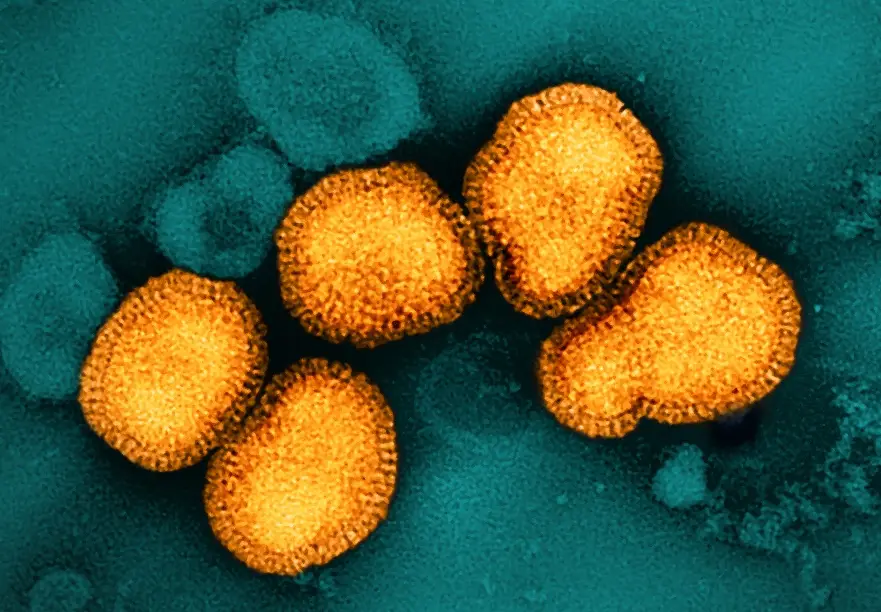
LA JOLLA, CA—La Jolla Institute for Immunology (LJI) Professor Sujan Shresta, Ph.D., will receive more than $2.4 million from the National Institute of Allergy and Infectious Diseases (NIAID) to help develop vaccines against viruses with pandemic potential. Over the next three years, Shresta will work closely with collaborators across the nation to test experimental vaccine strategies against deadly viruses from the flavivirus and alphavirus families.

“This work is an important part of LJI’s mission of pandemic preparedness,” says Shresta. “Both flaviviruses and alphaviruses cause numerous human diseases of global concern—and can cause explosive outbreaks with pandemic potential.”
This program is part of NIAID’s Research and Development of Vaccines and Monoclonal Antibodies for Pandemic Preparedness (ReVAMPP) Network, which encompasses eight research programs focusing on different virus families with pandemic potential. Shresta is a member of the Flavivirus and Alphavirus ReVAMPP (FLARE), which is directed by Michael S. Diamond, M.D., Ph.D., of Washington University School of Medicine in St. Louis, and co-directed by Richard Kuhn, Ph.D., of Purdue University.
Shresta and her colleagues in FLARE are investigating dengue virus (a flavivirus) and chikungunya virus (an alphavirus) as “prototype” viruses as they learn more about stopping members of these viral families.
These viruses have proven tough to develop vaccines against. Many flaviviruses and alphaviruses are tick- or mosquito-borne—and they’re spreading rapidly. In recent years, climate change has allowed more virus-carrying arthropods to reach new regions. This shift has left many more people vulnerable to dengue virus and chikungunya virus infection. Health officials are also seeing rising cases of Zika virus (a flavivirus), Powassan virus (a flavivirus), and eastern equine encephalitis (an alphavirus) in the United States.
Fortunately, Shresta is a leading expert in the development of mouse models of infectious disease. Her laboratory has used these mouse models to guide the development of vaccine candidates against several flaviviruses and even SARS-CoV-2, a coronavirus that causes COVID-19.
As a member of FLARE, Shresta will use mouse models to test potential dengue virus and chikungunya vaccine candidates and vaccine platforms sent to her by scientists at collaborating institutions. Her team will harness LJI’s high containment (BSL-3) facility and LJI Core Facilities to study vaccine responses in detail and determine which approaches are most successful.
“If we can pair the most promising vaccine candidates with the optimal vaccine platforms, we’ll have the pieces in place to rapidly combat future outbreaks, epidemics, and pandemics,” says Shresta.
This is NIAID grant number 1U19AI181960.
Learn More:
LJI Center for Vaccine Innovation
WashU Medicine leads two major pandemic preparedness research projects
Research and Development of Vaccines and Monoclonal Antibodies for Pandemic Preparedness (ReVAMPP)
###